Sunday, September 14, 2014
It's the Light
On a recent P-day we took the opportunity to travel to Springbrook Mountain, a World Heritage Area. Springbrook is a plateau that was formed millions of years ago from a massive volcanic eruption and is now part of the Gondwanna Rainforest. There was a beautiful clear blue sky as we left the Briabane area but by the time we reached Springbrook the sky was cloudy and it looked like we were going to see why it is a rainforest. When we arrived at the national park we carefully planned the places we would visit. Beginning with a drive through the rainforest where we saw wallabys for the first time in the wild, they are fast and stay hidden, too fast for us to get a picture. We saw cookaburos, they might have been sitting in a gum tree. We arrived at an area called the Best of All Lookout. After a gentle fifteen minute walk through the rainforest where he saw beautiful Antarctic Beech trees that are about 2,000 years old we came to the lookout. The view was stunning, we could see Mt Warning and beyond to Byron Bay. The clouds were thickening and you could see the rain approaching from the distance. Returning to the car we next went to the Canyon Lookout. When we arrived it was raining lightly but undeterred we donned our rain jackets and umbrellas and went to the viewing point. The Canyon Lookout overlooks the valleys created by erosion, we took several pictures and back to the car for the next stop. When we arrived at Goomoolahra Falls in the rain we followed the cool creek that runs through the forest and cascades over the rocks to the canyon floor 80 meters below. The view from the top of the falls was fun with more pictures taken under umbrellas. When we returned to the car the rain had stopped and the sun was coming out. Being the photographers that we are we thought we would return to the Canyon Lookout to see if there was any difference in the sunlight. This time no umbrellas, the sun was shining and the clouds were dispersing. From the lookout point the beautiful green color of the forest below popped. The shadows created by the sunlight gave greater definition to everything, this time we could see just how jagged the cliffs are and the layers of lava flow were apparent. We spotted several waterfalls that we didn't see the first time. The contrast created by the light really added to the visual feast we were having. This time we stood and pondered just how beautiful the creations of God are and thought about how the Light of Christ can have such an impact in people's lives. We watch each week how when people are taught the gospel their lives begin to light up. Their countenance becomes brighter, their smiles are numerous and they have more purpose in life which seems to make them happier. Timing our day to end it with a hike at dusk to the Natural Bridge and Glow Worm cave. We discovered that glow worms are really fly larvae that create a chemical reaction to glow in the dark to attract flies and insects to be captured and consumed by them. As it became dark the glow worms began to appear on the cave ceiling like stars in the night sky. Who knew glowing fly larvae could be beautiful, but then we saw a lot of beauty on Springbrook Mountain, Australia.
Saturday, August 30, 2014
Thar She Blows!
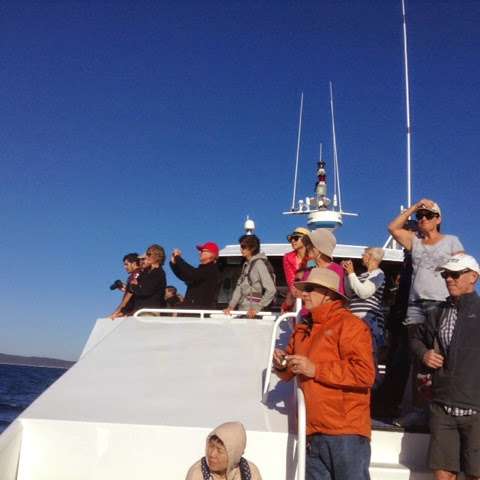
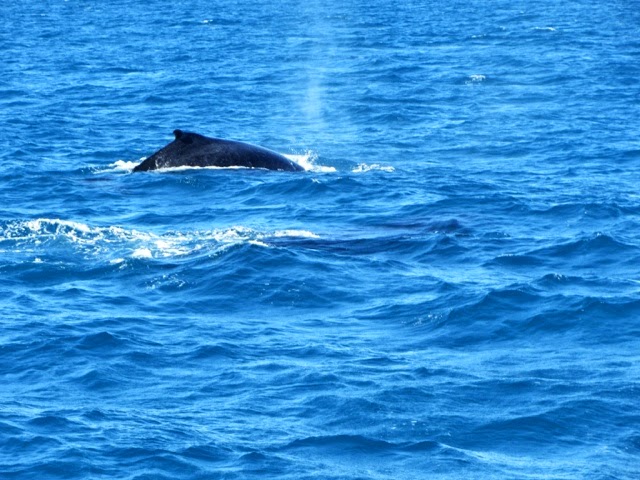
The second day of our get away we went whale watching. We were in Hervy Bay, which is an area where the whales migrate to to have their babies. We started out on a sailboat, which would be cool (but all day excursion) Because when we saw whales we would be close to the water and be up close and personal. But about an hour and a half into our journey to where the whales were that day the steering on the boat broke and we had to turn around, they offered us a voucher to come back but we weren't sure we would make it back, so after a lunch on shore we decided to seize the day and got on a faster, larger boat for an afternoon tour. It took about an hour to get to where some whale pods were and for the next two hours we were delighted to see whales swimming around and underneath the boat. They would roll on their backs, wave a fin at all the funny looking creatures on the boat who would all wave back at them. A few came in for a closer peek at us. If we had ten foot arms we could have touched them. The whales we saw were humpback whales. They put a microphone in the water and we heard the whale song. We saw them swirling, rolling, spouting, waving and of course the famous whale tails. We did see two breaching or coming out of the water. Whales can reach between 40 to 50 feet long and can weigh up to 48 tons. They are grey or black in color with white markings which are different for every whale allowing researchers to identify them individually.
It was a great day, even with the broken sail boat. We are so glad we were able to go. We enjoyed being with the Rancies, seeing the whales up close and being on the beautiful, clear waters of Australia.
Saturday, August 23, 2014
Frasier Island
We were able to take a couple of days off and travel north to the Hervey Bay Area with our friends Rob and Rae Rancie. We spent one day on Fraiser Island and one day whale watching (more about that later)
Fraiser Island is the largest sand island in the world. It is also a world heritage site. We were picked up at our hotel in Hervey Bay and taken to the ferry. After about an hour ferry ride we were on Fraiser Island. We had purchased a tour. Only four wheel drive vehicles are allowed on the island. Most of the "roads" are sand tracks with trees on both sides. Bumpy, hilly roads. We were in a four wheel drive bus and we were so grateful that a few days prior there had been a huge rainstorm so the tracks were smoother than usual, but it was still a real roller coaster ride!
We first went across the island, which is about 22 kilometers wide and 125 kilometers long, to the eastern shore where we drove along the beach for about 12 kilometers. It was beautiful!
We drove to a ship wreck, the Maheno. The ship was a cruise ship in 1905, during World War One it was put into service as a hospital ship, then it was back to a cruise ship. It was being towed after having been sold to china, but a cyclone came up, the tow line broke and the storm pushed it to shore on Frasier Island and they couldn't move it. It is slowly being covered by sand and eroding. Someday it will be totally covered.
There are Dingos all over the island, these are wild dogs. They were brought to australia by Asian seafarers about 4000 years ago. There are warning signs all over the island warning people about them. They are a sub species of the grey wolf and can be dangerous and aggressive. Parents are especially warned about keeping small children close to them. We did see some on the beach.
We also purchased a short, small airplane ride that flew over the island. It took off and landed back onto the beach. This island is only one of two places in the world where private aircraft can take off and land on the beach. We next went to Eli's Creek, a beautiful, clear creek people could wade or float in. After lunch we took a 1.8 kilometer hike on a trail through the rain forrest. We ended the tour at McKenzie lake. Where one of us, bet you can't guess which one, waded in the water. Back on the bus for a roller coaster ride back to the ferry. Once back in Hervey Bay we ended the day with fish and chips and a ice cream cone! Beautiful day!
Sunday, August 3, 2014
Beautiful Stradbroke Island
Stradie as Stradbroke island is called by the locals is a beautiful sand island. Our friends Rob and Rae Rancie asked us to go over for the day. We took a large ferry, Rob drove their car on, then we went up on top of the ferry to enjoy the sunshine and the journey over. It was a smooth crossing that took almost an hour. Stradbroke is now home to the Nooncuccal, Nughee and Goenpul Aboriginal people who call it Minjerribah. The first European recorded sighting was in 1770 when James Cook named point look out. Today a lot of people vacation there, it is not a huge island nor fancy but it is popular for fishing, surfing, swimming, scuba diving and whale watching (this time of year). The day we were there we saw people doing all of the above except scuba diving. We even saw a surfing class. As a bonus we saw a kangaroo eating his lunch (grass) on the side of the road. We also enjoyed our lunch at a seaside restaurant while we watched the really large waves come in. We saw whales spouting, but none that came out of the water. In a few weeks we are going to another spot where they are migrating to to give birth. Beautiful scenery, beautiful beaches, beautiful day!
Tuesday, July 29, 2014
On The Move
Our new place is nice. I'm thrilled to tell you it is air conditioned, after last summer it was high on my priority list. We were able to move the king size bed we inherited from the Miles, it just fit. We were so grateful to four strong young missionaries who helped us for a few hours and Elder and Sister Hansen who also helped. Elder and Sister Hansen moved into our place, they were just next door in the apartment we were in when we first came. That location works well for their assignment.
Sister Hansen bought me the tulip painting you see in the living room or lounge as they say here. It was a thank you gift. I saw it at a store and really liked it, I told her about it and she went and bought it for me, I wish I could bring it home, but I won't, I hope whoever inherites it will like it too. In the picture of the outside of the apt. Building Ken is standing by where you go in to our little patio area. In one picture you can see a sign in the background that says Coles, that is a small grocery store. We call it the big refrigerator. Our fridge is so small we appreciate having a big one across the street.
Winter here is so lovely, day time temps in the seventies, very little humidity, cool nights and mornings, beautiful! Great walking weather and we plan to be doing more of that now we have a much, much shorter commute to work!
Saturday, July 5, 2014
Joyful June
Our mission had a goal, 100 baptisms In the month of June. There has been a real can do attitude as the missionaries took this goal to heart. Everyone worked hard, they found, taught and loved 105 people into the waters of baptism. When President Hamula toured the mission in May he told President Henderson we could baptise 100 people a month. This has never been done in this mission, it is usually around sixty. The missionaries experienced many miracles in their finding and the wards and stakes stepped it up. There was a special fast held for missionary work, challenges were made and met. Multiple members of families were baptised on the same day.
We have not been on the front lines but we have been at Command Central, doing what we can to help. One of those things is entering the baptism forms into the CDE program. CDE stands for Convert Data Enrty. We know that behind each of the forms is a person, a child of God. Each form is a story. The form lists the birth place of the person being baptised. They are from everywhere, all around the world, several from China, New Zealand, England, Sri Lanka, Iran, Philippines, even the U.S. As they are entered it is easy to wonder about that particular person and their conversion story. If you have any interest check out the Mission blog, you will find individual stories there. Australiabrisbanemission.com.
Here is a picture. This is what 105 baptism forms looks like. They are usually entered in batches of five to eight. We were blessed with a couple relatively quiet days in the office to complete this task by the deadline. We have dedicated, wonderful missionaries in the Australia Brisbane Mission and 105 new members of the church in Queensland! Hooray for Israel!!!
Saturday, June 21, 2014
Queensland Nuts
In Queensland there are many beautiful trees, we love them. Someday we will do a post on some of the different trees because they are amazing. A few weeks ago we were invited for dinner at an Aussie couples home, they were telling us about Queensland nut trees. They said that when they were growing up every home had two trees; a Queensland nut tree and a mango tree. They said how popular the nuts are and how prevelant but how much work they are to get out of their shells. The next week they brought us a sack of nuts that they had picked up on a walk. They also brought us their nut cracker, we have had fun trying to use it. I'm told there is a whole cottage industry of people trying to make the best nut cracker to crack the dry hard shells. The nuts start out green, turn a brown black color. Then they start to split open. Inside the split open outer shell is another shell that is brown and hard. When you get that shell open there is a white nut. You might know these nuts by another name, macadamias! When you finally get to eat one it is really good, now we know why they are so expensive, you go through a lot before you can put one in your mouth. Right out of the shell they are a little softer than other macadamias we have eaten, but they still taste great!
There is a life lesson here. Some things are hard to achieve, but when you work hard the reward can be worth the effort. We are grateful for life lessons, for friends who give us nuts and for our friends and family (who are all a little nuts!)
Subscribe to:
Posts (Atom)